What Are The Marietas Islands Known For?
The Marietas Islands are known for Hidden Beach, blue-footed boobies, a protected coral reef and strict national park rules. Here is what the islands are famous for and how to see it.
A small archipelago in Banderas Bay, a crater beach you swim into through a rock passage, and cliffs where CONANP lists blue-footed boobies among the park's wildlife: the Marietas Islands pack a lot of fame into two islands, two islets and some rocky shoals. CONANP, the National Commission of Protected Natural Areas, administers the whole area as Parque Nacional Islas Marietas, which explains the second thing the islands are known for: rules. Access is by boat only, through authorized providers, on a fee of MXN 125 per person per day, and the famous beach inside the crater, Playa del Amor, is open only Wednesday to Sunday.
Most people encounter the islands on a tour from Puerto Vallarta, Nuevo Vallarta or Punta de Mita. The bookable options range from a collective boat from Punta de Mita from $67 per person to a private snorkeling safari from $369 per group, and the featured snorkel tour from Marina Vallarta, the Eco Explorer Vallarta trip with an optional Hidden Beach landing, runs from $99 per person and carries a 4.8 rating from 1,033 reviews. What you actually see on the day depends on tide, sea state and the park's daily rules, and good listings say so. If snorkeling is the main draw for you, our guide to snorkeling at the Marietas Islands covers where the boats stop, what the park permits, and how Hidden Beach fits in.
Four Things That Make The Islands Famous
The Marietas Islands are known for four things: Hidden Beach, the crater-bound beach also called Playa del Amor or Playa Escondida; the blue-footed and brown booby colonies CONANP lists as park wildlife; a protected coral reef with giant mantas and spotted eagle rays; and national park status that limits access to authorized boats and caps time on the famous beach. Everything else, the cliffs, the birds, the snorkeling, flows from that protected status. Since tour listings throw these names around interchangeably, this guide to which name means which beach at the Marietas Islands sorts out the confusion before you book.
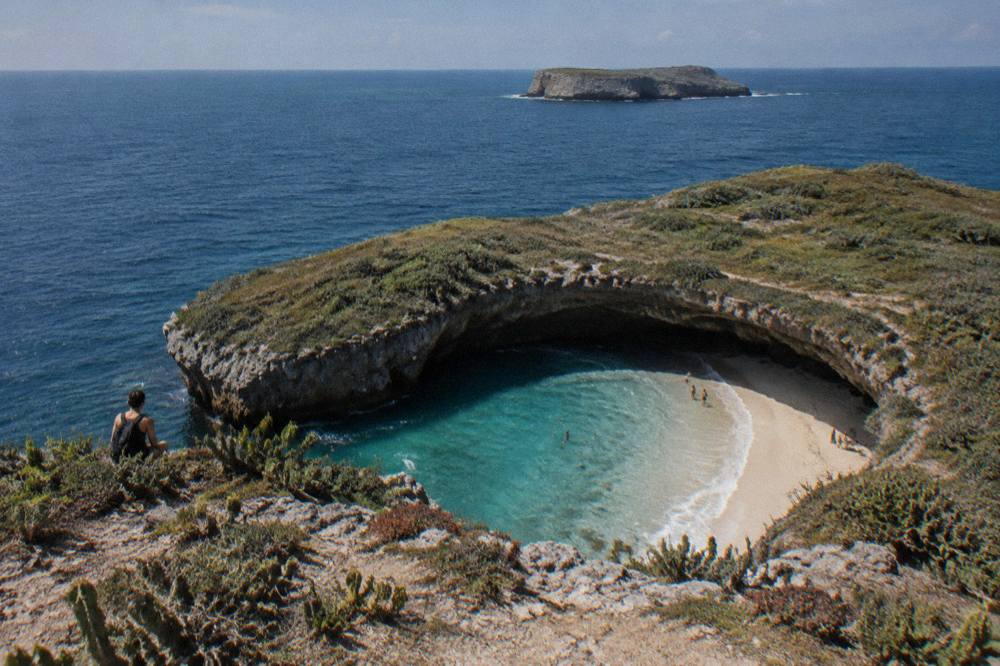
Hidden Beach is the image that travels. It is a beach inside a collapsed crater, reached by swimming through a natural rock passage, and it appears on most Puerto Vallarta promotional material for a reason: the aerial view of a sandy strip inside a ring of rock is instantly recognizable. CONANP's own park page lists Playa del Amor among the site's features alongside the boobies and the coral reefs, which tells you the beach is not a secret so much as a managed icon.
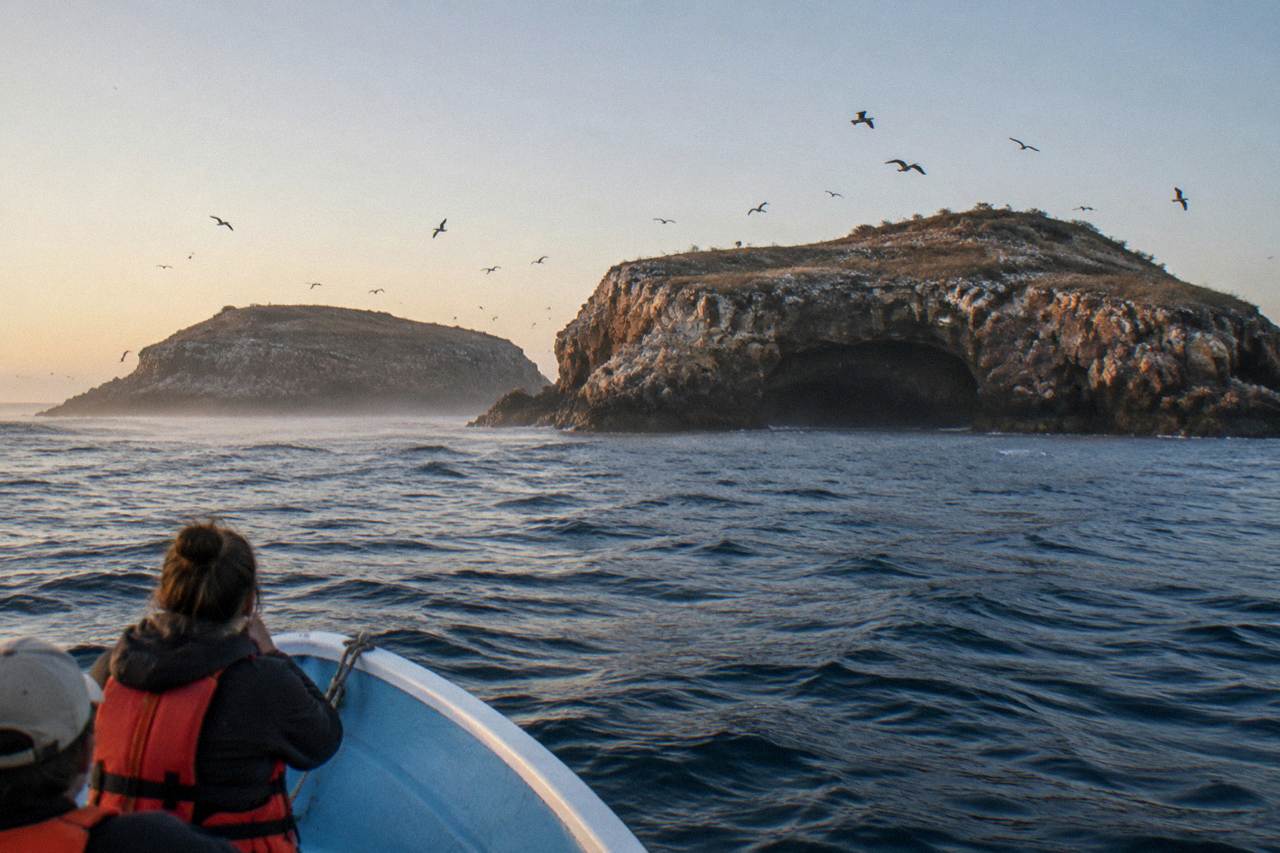
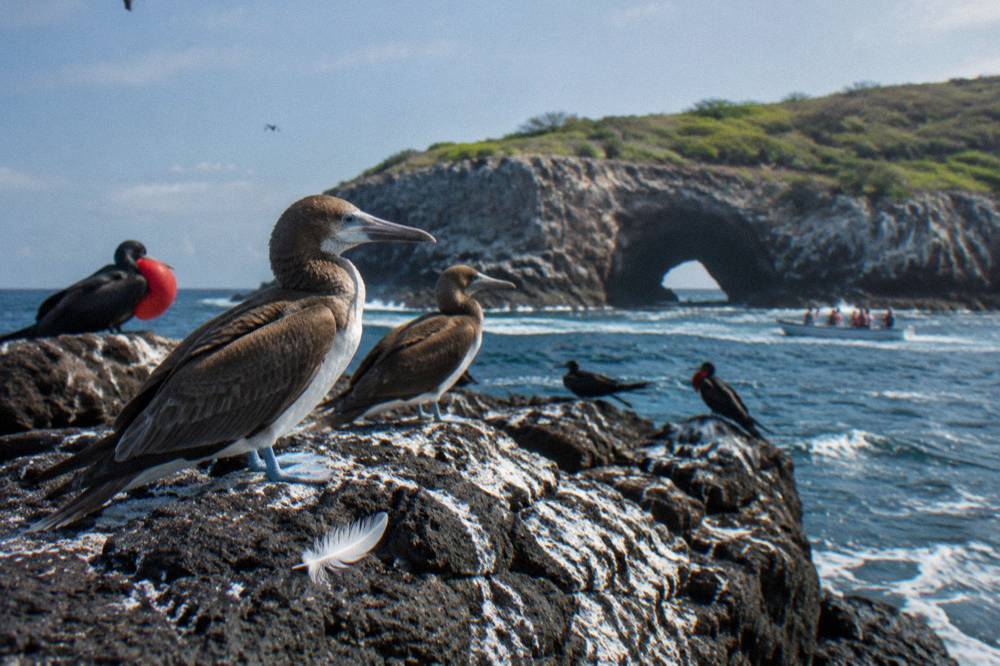
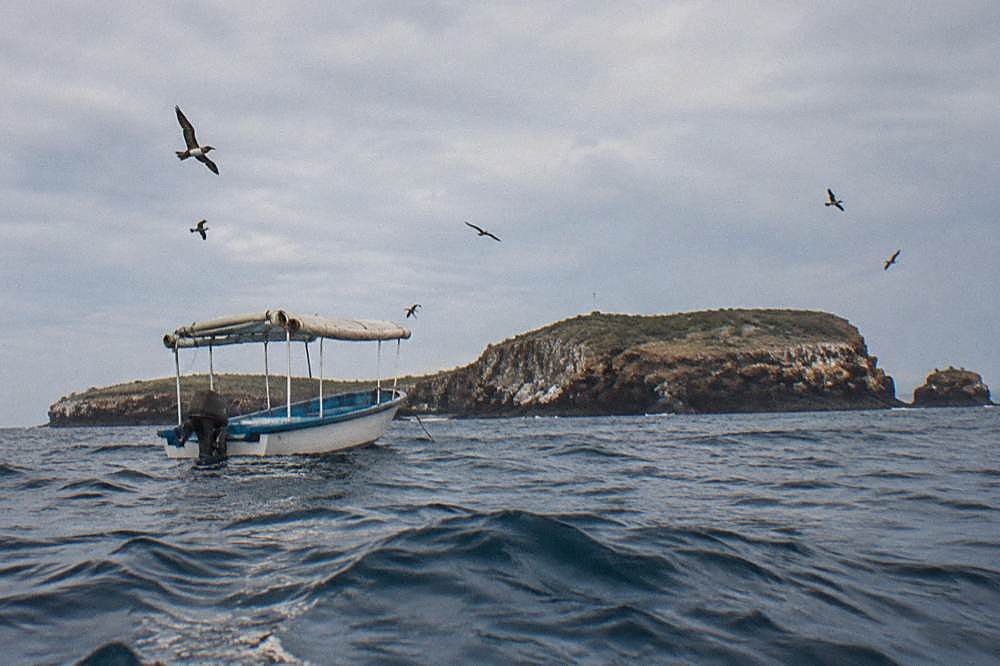
The bird colonies are the second claim to fame. CONANP lists the blue-footed booby, the brown booby, Heermann's gull, the frigatebird and the bridled tern as park wildlife, and several tours describe bird watching around the cliffs as a standard part of the circumnavigation. A secondary academic study of Isla Larga placed blue-footed booby breeding roughly February to July with a peak in March to May, so spring is when nesting activity is described as most visible, though the park sources publish no month-by-month sighting data.
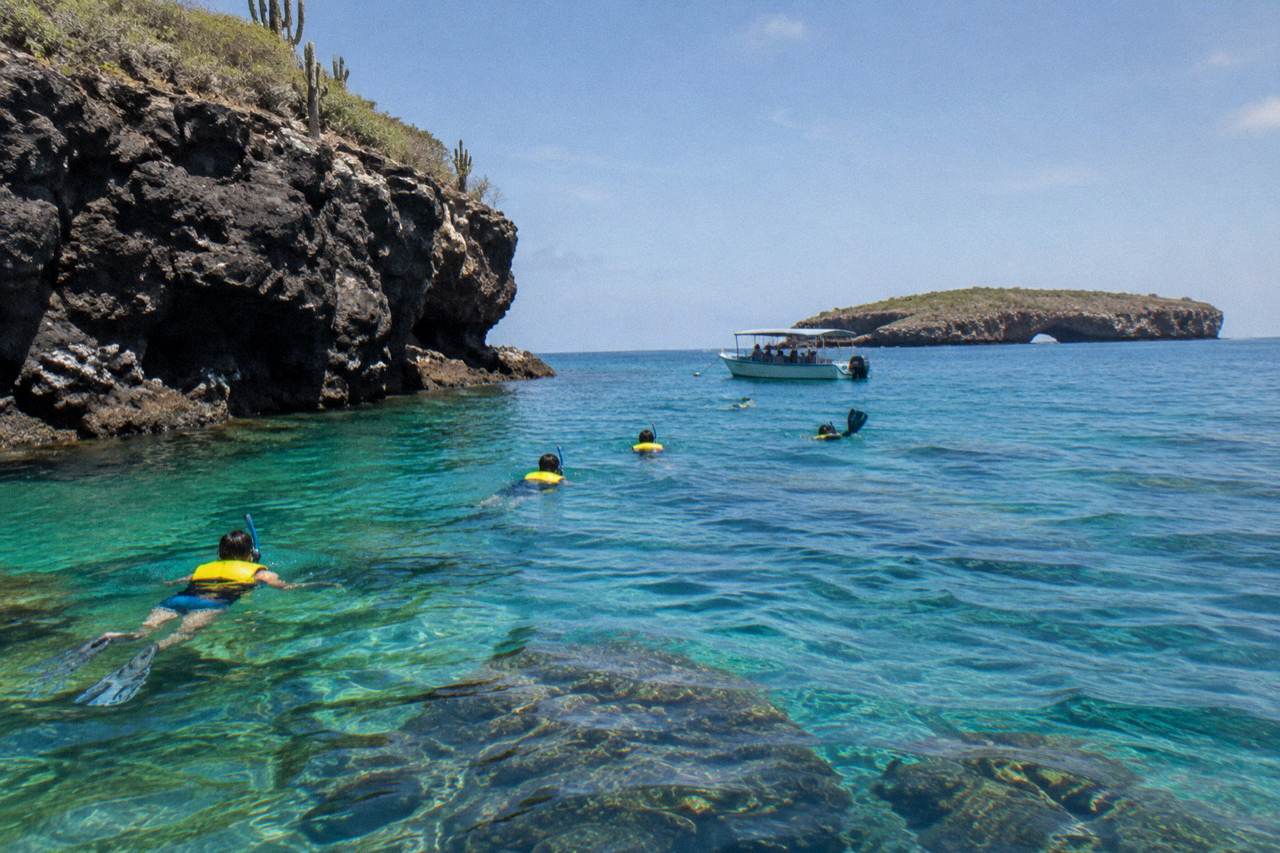
Third, the reef. The park's listed marine life includes the king angelfish, the giant manta, the spotted eagle ray and coral reefs, and snorkeling is one of the activities CONANP permits inside the protected area. Tours run snorkel stops at sheltered spots several listings name, including Playa Nopalera, a separate beach that is not Hidden Beach. Water clarity varies day to day, as guest reports on the listings make plain.
Why Is Hidden Beach The Islands' Most Famous Sight?
Hidden Beach, or Playa del Amor, is famous because it sits inside a volcanic crater and can only be reached by swimming through a rock passage, and because CONANP closed it on 9 May 2016 for coral restoration and reopened it under strict 2016 reopening rules, groups of at most 15, 30 minutes per group, helmets and vests compulsory, and at most 116 visitors a day, which operators still describe. Scarcity made it famous; regulation keeps it that way.
The beach is also called Playa Escondida in some listings, and CONANP uses Playa del Amor; they are the same site, distinct from Playa Nopalera where many tours stop to swim and snorkel. Two listings give a sense of the swim: the sightseeing tour from Puerto Vallarta states a swim of about 60 meters through the passage for its full-package option, and one Puerto Vallarta snorkel listing states about 250 meters from the boat. There is no general official tunnel length, so treat both as that listing's description.
CONANP closed Playa del Amor on 9 May 2016, reopened it after University of Guadalajara experts found coral restoration progressing, and set the conditions above, plus a ban on fins, mask or snorkel at the beach entrance and a rule that boats carrying more than 15 passengers may not enter the public and restricted use areas. The current CONANP page gives the Wednesday to Sunday beach hours, 8:00 to 17:00, and the MXN 125 fee, but not the caps, and no newer figures have been published. Several listing-level rules, a 10-minute beach visit on one Ecotours Vallarta listing, age limits of 10 to 65 on others, are per-listing facts and stay attributed to those listings.
Entry is never certain. Tide, sea state, the park's daily rules and the operator's call on the day all decide, and guests report tours redirecting to snorkeling when the beach is not reachable. Any listing title containing the word "guaranteed" is a listing name, not a promise this site will repeat.
If Hidden Beach is the reason you are looking at the islands, the format choice matters more than the operator. Short Punta de Mita boats such as the Shark's Hidden Beach, 3 Hours tour, from $157 per person and rated 4.8 from 161 reviews, list the landing as included and cap the group at 8; long Puerto Vallarta catamarans usually treat the landing as an optional extra or skip it entirely. The featured Eco Explorer Vallarta snorkel tour lists the landing as an optional extra with a cash entrance fee of MXN 600 per person stated on its listing.
Why Are The Islands Known For Blue-Footed Boobies?
The Marietas Islands are known for blue-footed boobies because CONANP officially lists both the blue-footed booby and the brown booby as park wildlife, and the islands function as a nesting site on cliffs and rocky ledges that visitors see from the water on nearly every tour. The park sources publish no counts and no colony-size claim, and this site does not either.
What can be said firmly sits in CONANP's own species list: blue-footed booby, brown booby, Heermann's gull, frigatebird, bridled tern, alongside the marine species. The circumnavigation that every boat tour does passes close enough to the cliffs for bird watching, and several listings name it explicitly, including the private safari listing that lists bird watching among its inclusions and the small-group tour from Punta de Mita that does the same.
The seasonal picture is softer. A 2013 academic study of Isla Larga, a secondary source, put blue-footed booby breeding roughly February to July, peaking March to May, so nesting behavior is described as mostly a spring phenomenon. The birds are not described as present in the same numbers every month, and no count of nesting pairs is given. A dedicated companion piece, the blue-footed boobies of the Marietas Islands, goes deeper on the birds and which listings mention them.
One park rule connects the birds to tour operations: several listings prohibit drones, citing federal regulations and the flight path of endemic birds. That is why your Hidden Beach photos from any tour will be taken from the water or the sand, never from the air.
What Is The Reef And Marine Life Known For?
The underwater side of the islands is known for coral reefs and for species CONANP lists officially: the king angelfish, the giant manta, the spotted eagle ray and the humpback whale, which appears in the bay seasonally. Snorkeling is a permitted activity inside the park, with life jackets mandatory in the water and reef-friendly sunscreen required 30 minutes before entering.
The snorkel product on the ground is broad. Eight of the tours on this site sit in the snorkel-boat category, from the 3 hour 30 minute Vallarta Adventures run to a 5 hour Ecotours Vallarta trip from $136 per person, rated 4.9 from 18 reviews, which lists up to 3 hours in the National Park. Gear is listed as included on every listing; meals and bars vary by listing, so check each tour's own inclusions. The guide to snorkeling at the Marietas Islands compares them all.
Guest reports on the listings describe water clarity that varies day to day, from exceptionally clear to murky after swell, which matches the park's own climate note that the rainy season can bring days with poor sea conditions. Humpbacks are a crossing possibility in season, and the official window ran 8 December 2025 to 23 March 2026; the federal whale-watching notice restricts whale-watching activity within 1.5 km of the islands, and next-season dates have not yet been announced. The Chica Locca Tours snorkel, kayak and Playa Nopalera listing describes humpbacks as possible December to April; other listings say December to March; both are listing descriptions, not sightings promised.
Marine life CONANP lists for the park
| Category | Species CONANP lists |
|---|---|
| Seabirds | Blue-footed booby, brown booby, Heermann's gull, frigatebird, bridled tern |
| Fish and rays | King angelfish, giant manta, spotted eagle ray |
| Marine mammals | Humpback whale |
| Habitats and sites | Coral reefs, Playa del Amor |
Why Does National Park Status Shape Every Visit?
The islands are known for being a national park where nothing is casual: the park is open Tuesday to Sunday 8:00 to 18:00, Playa del Amor is open Wednesday to Sunday 8:00 to 17:00, entry costs MXN 125 per person per day as the conservation wristband, and access is by boat only through authorized providers of Banderas Bay. Eight official visitor rules apply, from mandatory life jackets to a ban on single-use plastics.
The fee comes with exemptions and discounts CONANP publishes: free entry for older adults, pensioners and retirees, people with disabilities and children under 12; 75 percent off for students and teachers with credential; 50 percent off for Mexican nationals and foreign residents with documents; foreign tourists pay the full MXN 125. Whether a given tour's ticket already covers the fee is a per-listing fact: the featured Eco Explorer Vallarta listing includes the CONANP bracelet and park permits, while the Chica Locca all-inclusive listing does not state the fee either way and several others list peso fees as excluded. There is a full guide to the park fee and conservation wristband.
The rules also explain the beach's weekly rhythm: the whole park is closed Monday, and Hidden Beach is closed both Monday and Tuesday, so a Wednesday to Sunday plan is the only plan. CONANP recommends light clothing and swimwear and does not allow footwear for water or beach activities, which surprises visitors who packed water shoes.
What Is The Boat Day To The Islands Like?
A Marietas boat day is known for combining the crossing, a circumnavigation of the cliffs, snorkel stops at spots like Playa Nopalera, and for some tours an attempt at the Hidden Beach landing, with departures from Marina Vallarta, Puerto Mágico, Los Peines pier, Paradise Village pier or Punta de Mita. Tour lengths run from 2 hours 20 minutes to 9 hours, and no listing states hotel pickup is offered.
CONANP's distance table shapes the day: Punta de Mita is 9 km from the islands, La Cruz de Huanacaxtle 11.84 nautical miles, Sayulita 12.68, Nuevo Nayarit 15.96 and Puerto Vallarta 34 km, which is why the short, small-group products cluster at Punta de Mita and the long catamaran days leave from the Puerto Vallarta terminal. No tour departs from La Cruz, Bucerias or Sayulita themselves, and no crossing time in minutes or hours is published.
The format choice is really a choice about what the islands are known for to you. The full-day all-inclusive catamaran from Chica Locca Tours, from $130 per person and rated 4.8 from 771 reviews, leans into the floating-party side: an open bar, waterslides, paddleboards, kayaks and a floating mattress, with a maximum of 66 travelers and Hidden Beach access listed as an extra fee. The small Punta de Mita boats lean into intimacy: groups of 8, a covered boat, a waterproof container for your phone, non-alcoholic drinks.
| Departure point | CONANP distance | What leaves from there | Example tour |
|---|---|---|---|
| Punta de Mita / Corral del Risco | 9 km | Small boats, 6 to 8 guests, Hidden Beach focused | Grimar collective boat, from $67, 4.9 from 32 reviews |
| Marina Vallarta | 34 km | Small-group snorkel boats, 10 to 16 guests | Featured Eco Explorer snorkel tour, from $99, 4.8 from 1,033 reviews |
| Puerto Mágico terminal | 34 km | Large catamarans, 40 to 100 travelers | Vallarta Adventures BBQ day, from $79, 4.3 from 1,150 reviews |
| Paradise Village pier, Nuevo Vallarta | 15.96 nmi | Mid-size sail and power trips | GoPralia sailing trip, from $99, 3.4 from 11 reviews |
At the other end, the Punta de Mita specialists run short, landing-focused mornings where the whole product is built around the crater beach and the cliffs. Tours from Punta de Mita and La Cruz compare them in detail, including the Grimar and Shark's Tours small boats.
What Else Are The Islands Known For Alongside?
Alongside the headline sights, the islands are known for the strictly limited Hidden Beach access described by the 2016 reopening rules CONANP set and operators still describe, for being reachable only on paid authorized boats, and as a fixture of Puerto Vallarta and Riviera Nayarit day-tripping, with combo days that pair the islands with Majahuitas on the same ticket.
The combo format is common among these tours: the most reviewed tour of all 30 listings, the Vallarta Adventures BBQ day at Majahuitas, from $79 per person with 4.3 from 1,150 reviews, states plainly that it does not visit Hidden Beach and instead builds the day around Majahuitas cove. Guests on several listings describe humpback sightings on the winter crossing, dolphins near the boat, and the cliff circumnavigation as the moments that land hardest, always as possibilities rather than promises.
The islands' fame also has a practical edge travelers should know: because access is by authorized boat only, there is no independent kayak, paddleboard or private-boat entry, only CONANP's wording that movement is by authorized providers' boats. The companion article on visiting the Marietas Islands without a tour answers that question directly. For sizing up whether a paid day is worth it, is a Marietas Islands tour worth it works through the value question with real prices.
Another Playa del Amor exists on a different Mexican coast; this page is about the Marietas one in Banderas Bay.
Whichever format fits, the picture is the same: the Marietas Islands are known for a beach you may or may not get into, birds you will likely see from the water, reefs you can snorkel under rules, and a park service that keeps all of it on a short leash.
Common Questions About The Marietas Islands
What Is The History Of The Marietas Islands?
The park closed Playa del Amor on 9 May 2016 for coral restoration and reopened it under strict conditions: groups of at most 15, 30 minutes per group, helmets and flotation vests compulsory, no fins or snorkel at the entrance, and at most 116 visitors a day, rules operators still describe and CONANP has published nothing newer. Claims about military testing or heritage designations are not documented and are not repeated.
Can You Get To Hidden Beach Without A Tour?
No. Access to the park is by boat only, with authorized private tourism providers of Banderas Bay, and there is no independent entry option. Every tour on this site is a paid boat ticket, from $67 per person for the Punta de Mita collective boat upward, plus the park fee where the listing does not include it.
Are The Blue-footed Boobies Guaranteed On A Marietas Tour?
No sighting of any animal is ever guaranteed. CONANP lists the blue-footed booby and brown booby as park wildlife and tours describe bird watching around the cliffs on the circumnavigation, but the park sources publish no counts and no month-by-month presence data. A secondary study put breeding roughly February to July, peaking March to May.
Is Hidden Beach Open Every Day?
The Playa del Amor site is open Wednesday to Sunday, 8:00 to 17:00, so it is closed Monday and Tuesday, and the whole park is closed Monday. Even on open days, entry depends on tide, sea state and the park's daily rules, and tours can redirect to snorkeling when the beach is not reachable.
Do Marietas Islands Tours Include Hotel Pickup?
No tour on this site states that hotel pickup is offered; several state it is not included. Plan to reach the listed meeting point yourself, whether that is Marina Vallarta, the Puerto Mágico terminal, Paradise Village pier or a Punta de Mita office, and check the listing for exact arrival instructions.